Table of Contents
1. Introduction & Overview
The Transformer architecture, since its introduction by Vaswani et al. in 2017, has become the de facto standard for state-of-the-art Natural Language Processing (NLP). Its core innovation, the self-attention mechanism, allows the model to dynamically weigh the importance of all tokens in a sequence when processing each token. However, this mechanism comes with a significant computational cost, scaling quadratically ($O(N^2)$) with sequence length ($N$), which limits its efficiency for long documents or high-throughput applications.
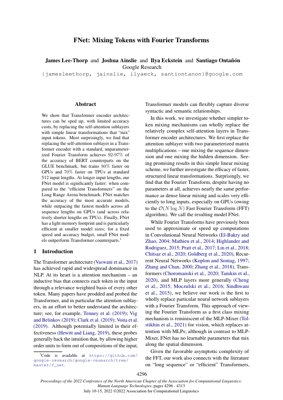
This paper, "FNet: Mixing Tokens with Fourier Transforms," presents a radical simplification. The authors investigate whether the computationally expensive self-attention sublayer can be replaced entirely with simpler, linear token mixing mechanisms. Their most surprising finding is that using a standard, unparameterized 2D Discrete Fourier Transform (DFT) achieves 92-97% of the accuracy of BERT models on the GLUE benchmark while training 80% faster on GPUs and 70% faster on TPUs for standard 512-token sequences.
2. Methodology & Architecture
2.1. Replacing Self-Attention
The core hypothesis is that the complex, data-dependent mixing performed by self-attention might be approximated or replaced by fixed, linear transformations. The authors first experiment with parameterized linear mixing layers (dense matrices). Observing promising results, they explore faster, structured linear transformations, ultimately settling on the Fourier Transform.
2.2. The Fourier Transform Sublayer
In FNet, the self-attention sublayer in a standard Transformer encoder block is replaced with a 2D Fourier Transform. For an input representation $X \in \mathbb{R}^{N \times d}$ (where $N$ is sequence length and $d$ is hidden dimension), the mixing is performed as:
$\text{FNet}(X) = \mathcal{F}_{\text{seq}}(\mathcal{F}_{\text{hidden}}(X))$
Where $\mathcal{F}_{\text{hidden}}$ applies the 1D Fourier Transform along the hidden dimension ($d$) and $\mathcal{F}_{\text{seq}}$ applies it along the sequence dimension ($N$). Only the real components of the transformed result are retained. Crucially, this sublayer has no learnable parameters.
2.3. FNet Model Architecture
An FNet encoder block retains the rest of the standard Transformer architecture: a feed-forward network (FFN) sublayer with nonlinearities (e.g., GeLU), residual connections, and layer normalization. The order is: Fourier mixing sublayer → residual connection & layer norm → FFN sublayer → residual connection & layer norm.
3. Technical Details & Mathematical Formulation
The 1D Discrete Fourier Transform (DFT) for a sequence $x$ of length $N$ is defined as:
$X_k = \sum_{n=0}^{N-1} x_n \cdot e^{-i 2\pi k n / N}$
For the 2D transform applied to the input matrix $X$, it is computed as two sequential 1D transforms. The use of the Fast Fourier Transform (FFT) algorithm reduces the complexity of this operation to $O(Nd \log N)$ for the sequence dimension transform, which is significantly better than the $O(N^2 d)$ of standard self-attention for large $N$.
The key insight is that the Fourier Transform performs a global mixing of all input tokens in the frequency domain, which may capture similar global dependencies as self-attention but through a fixed, mathematical basis rather than a learned, data-dependent one.
4. Experimental Results & Performance
4.1. GLUE Benchmark Results
FNet models (Base and Large sizes) were evaluated against BERT counterparts. The results are striking:
- FNet-Base achieved 92.2% of BERT-Base's average GLUE score.
- FNet-Large achieved 97.3% of BERT-Large's average GLUE score.
This demonstrates that most of the accuracy of carefully tuned self-attention models can be recovered with a simple Fourier mixing mechanism.
4.2. Long Range Arena (LRA) Benchmark
On the LRA benchmark, designed to test model performance on long sequences (1k to 4k tokens), FNet matched the accuracy of the most accurate "efficient Transformer" models. More importantly, it was significantly faster than the fastest models across all sequence lengths on GPUs.
4.3. Speed & Efficiency Analysis
The performance gains are substantial:
- Training Speed: 80% faster than BERT on GPUs, 70% faster on TPUs at 512 sequence length.
- Memory Footprint: Lighter than standard Transformers, especially beneficial at smaller model sizes.
- Scaling: The $O(N \log N)$ scaling of FFT gives FNet a decisive advantage over even linear-time ($O(N)$) attention approximations on GPUs for long sequences, as those methods often have large hidden constant factors.
5. Analysis Framework & Case Example
Case: Text Classification on Long Documents
Consider a task like classifying legal contracts or scientific articles, where documents regularly exceed 2000 tokens. A standard Transformer model would struggle with the quadratic memory and compute cost. An "efficient" linear Transformer might help but can be slow in practice due to kernelization overhead.
FNet Application: An FNet model can process these long sequences efficiently. The Fourier sublayer globally mixes token representations in $O(N \log N)$ time. The subsequent FFN layers can then build features on these mixed representations. For a fixed latency budget, one could deploy a larger FNet model than a comparable Transformer, potentially recovering the slight accuracy gap noted on shorter sequences.
Framework Takeaway: FNet shifts the inductive bias from "data-driven relational weighting" (attention) to "fixed global spectral mixing." The success of FNet suggests that for many NLP tasks, the ability to combine information globally is more critical than the specific, learned method of combination.
6. Core Insight & Critical Analysis
Core Insight: The emperor might have fewer clothes than we thought. FNet's success is a provocative challenge to the NLP orthodoxy. It demonstrates that the sacred cow of self-attention—often considered the indispensable source of the Transformer's power—can be replaced by a parameter-free, 150-year-old mathematical operation with only a minor performance penalty but massive efficiency gains. This suggests that a significant portion of the Transformer's capability stems from its overall architecture (residuals, FFNs, layer norm) and its capacity for global information flow, rather than the intricate, learned dynamics of attention itself.
Logical Flow: The paper's logic is compelling. Start with the expensive problem (quadratic attention). Hypothesize that simpler mixing might work. Test linear layers (works okay). Realize a structured transform like the FFT is even faster and scales beautifully. Test it—surprisingly, it works almost as well. The flow from problem to iterative solution to surprising discovery is clear and scientifically sound.
Strengths & Flaws:
Strengths: The efficiency gains are undeniable and practically significant. The paper is rigorously evaluated on standard benchmarks (GLUE, LRA). The idea is beautifully simple and has strong "why didn't I think of that?" appeal. It opens a new design space for efficient architectures.
Flaws: The accuracy gap, while small, is real and likely matters for SOTA-chasing applications. The paper doesn't deeply analyze why Fourier works so well or what linguistic properties are lost. There's a suspicion that its performance may plateau on tasks requiring very fine-grained, syntactic reasoning or complex, multi-step inference where dynamic attention is crucial. The reliance on GPUs/TPUs with highly optimized FFT kernels is a hidden dependency for the speed claims.
Actionable Insights:
1. For Practitioners: Strongly consider FNet for production deployments where throughput, latency, or cost are primary constraints, and a 3-8% accuracy drop is acceptable. It's a prime candidate for "good enough" large-scale text processing.
2. For Researchers: Don't stop at Fourier. This paper is a green light to explore the whole zoo of linear transforms (Wavelets, Hartley, DCT) and structured matrices as attention replacements. The core research question becomes: "What is the minimal, fastest mixing mechanism sufficient for language understanding?"
3. For the Field: This work, alongside contemporaries like MLP-Mixer for vision, signals a potential "back to basics" movement. After years of increasing architectural complexity, we may be entering an era of radical simplification, questioning which components are truly essential. It serves as a crucial reminder to periodically challenge fundamental assumptions.
7. Future Applications & Research Directions
- Hybrid Models: Combining FNet layers with sparse or local attention layers could create models that are both efficient and retain high precision for critical reasoning steps.
- Modality Extension: Applying FNet's principles to multimodal transformers (vision, audio). Early mixing of cross-modal signals via Fourier transforms could be highly efficient.
- Hardware-Software Co-design: Designing specialized AI accelerators optimized for the FFT operation could make FNet-like architectures even more dominant in efficiency-critical scenarios.
- Theoretical Understanding: A deeper analysis of what linguistic functions the Fourier Transform performs and how the FFN layers compensate for the lack of learned attention is a rich area for future work.
- Long-Context Modeling: FNet is a natural candidate for pushing the boundaries of context length in language models, enabling the processing of entire books or long conversations with manageable compute.
8. References
- Vaswani, A., et al. (2017). Attention Is All You Need. Advances in Neural Information Processing Systems.
- Devlin, J., et al. (2019). BERT: Pre-training of Deep Bidirectional Transformers for Language Understanding. NAACL-HLT.
- Tolstikhin, I., et al. (2021). MLP-Mixer: An all-MLP Architecture for Vision. Advances in Neural Information Processing Systems.
- Tay, Y., et al. (2020). Efficient Transformers: A Survey. ACM Computing Surveys.
- Wang, S., et al. (2020). Linformer: Self-Attention with Linear Complexity. arXiv preprint arXiv:2006.04768.
- Katharopoulos, A., et al. (2020). Transformers are RNNs: Fast Autoregressive Transformers with Linear Attention. International Conference on Machine Learning.
- Google Research. FNet Official Code Repository. https://github.com/google-research/google-research/tree/master/f_net